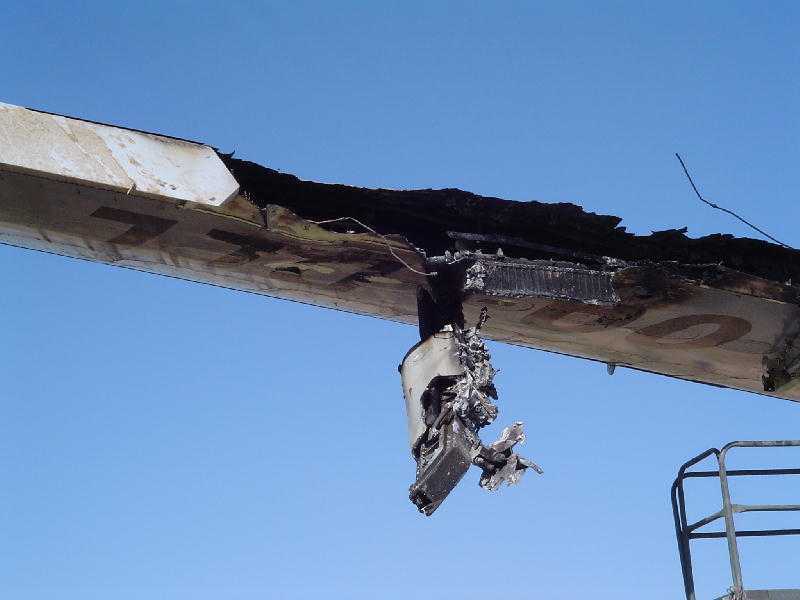
On 22 November 2003, a DHL A300, which had just departed from Baghdad on a cargo flight to Bahrain, was hit by a SAM-7 surface to air missile. The left wing caught fire following the hit, forcing the crew to return to the airport for a successful emergency landing.
A video about the event that was produced by Glenn Pew shows a reconstruction of the event, as well as several still photos of the missile damage.
On 2 November 2007, an F-15C aircraft from the Missouri Air National Guard experienced an in-flight breakup during an training mission. The pilot, Major Steven Stillwell, successfully ejected, but sustained injuries to his left arm and shoulder.
The investigation revealed that the accident aircraft had a structural failure in its upper right longeron, one of four critical support structures for the aircraft. Fatigue cracks in the longeron led to a structural failure of the longeron and the subsequent catastrophic breakup.
After the accident, more than 600 USAF F-15s were grounded and inspected. At least nine other F-15 aircraft were found to have similar fatigue cracks. some F-15s were also removed from service because of the costs of repairing these structural problems.
The video that was produced by Glenn Pew shows a reconstruction of the event, using computer animation based on data from the flight. Reconstruction of the In-flight Breakup
In the history of aviation, there have been many videos of missile attacks from the attacker's perspective, it is rare to have one from the other side. Below is a video shot from a Georgian Hermes 450 unmanned aerial vehicle (UAV) patrolling over the Abkhazia region of Georgia when it was apparently shot down by a missile from a Russian MIG-29. The Israeli-designed unarmed UAV never had a chance.
On 1 March 2008, a Lufthansa Airbus A320 arriving from Munich was attempting a landing at Hamburg, Germany under high crosswind conditions. The left wingtip struck the ground during the attempt, and the crew successfully executed a go-around. The aircraft landed without further incident. At the time, winds at the airport were gusting up to 49 knots. The left wingtip and winglet were damaged, and there were no injuries to any occupants..
This is the third update from AirSafe.com on the ongoing investigation into the accident at London's Heathrow Airport involving a British Airways 777. This update is based on information released by the AAIB on 18 February 2008, and focuses on analyses of the fuel system, the engines, and their associated control systems. You can listen to or watch the podcast at the following links:
The Air Accidents Investigations Branch (AAIB), the UK organization responsible for investigating the 17 January 2008 crash of a British Airways 777 jet at London's Heathrow Airport, released a second statement about the progress of the investigation on 23 January 2008. The video below summarizes the information in that second AAIB statement.
The Air Accidents Investigations Branch (AAIB), the UK organization responsible for investigating the 17 January 2008 crash of a British Airways 777 jet at London's Heathrow Airport, released a brief statement about the progress of the investigation the day after the accident. The video below summarizes the information in that AAIB statement, and adds additional information to put the accident investigation into a wider context.